
AI vs Manual Upsell: Which Drives Higher Revenue in 2025?
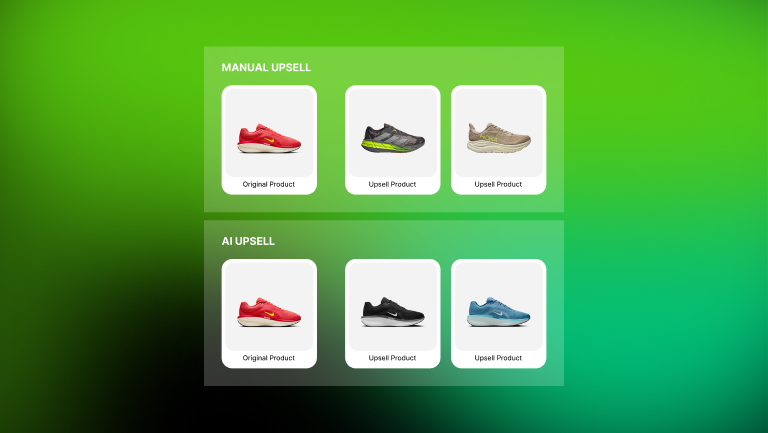
Table of content
I. Introduction
According to publicly cited industry analyses, an estimated 35% of Amazon’s revenue comes from its AI-powered product recommendation system. Brands that implement AI in their upsell strategy report an average 17-30% increase in Average Order Value (AOV). These figures don’t just highlight a trend-they signal a major shift in how eCommerce brands engage with consumer behavior: from instinct to data, from manual to automated, from static to real-time personalization. In my own work with Shopify merchants, I’ve seen this shift firsthand. Stores that once relied on manually configured upsell rules began to struggle as product catalogs and traffic increased, while AI-driven systems showed measurable gains in both scalability and consistency.
This shift has sparked ongoing debate across the e-commerce industry. While AI-driven upsell systems are becoming standard for large-scale retailers, many brands still rely on manual upsell strategies for control, experimentation, and brand-led campaigns. Let’s dive into a comprehensive comparison between AI and manual upsell approaches-evaluating implementation costs, control levels, effectiveness, and future trends-to help you find the best fit for your store in 2025.
II. Manual vs. AI Upsell
1. What is Manual Upsell?
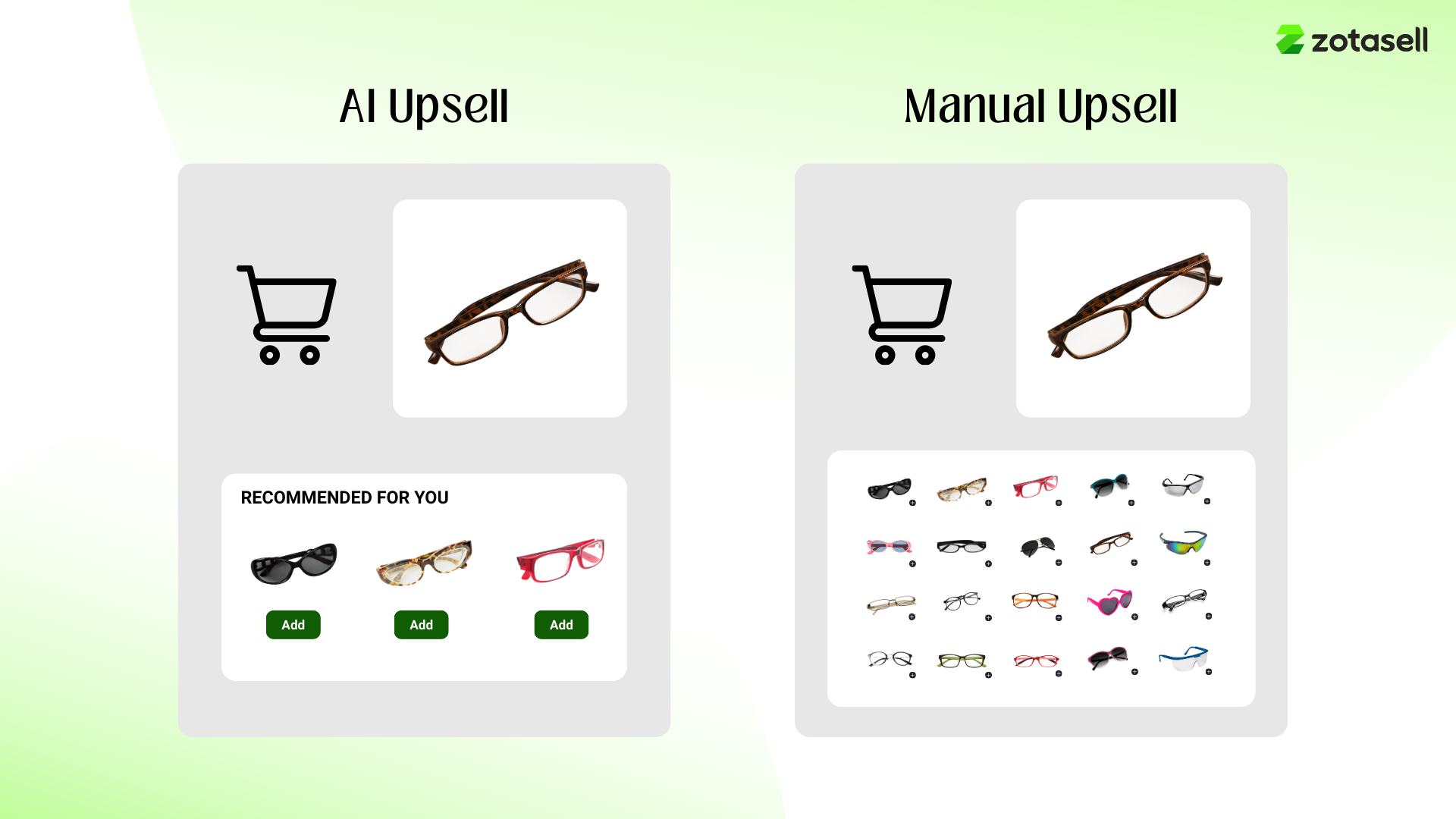
Manual upsell involves the seller making all product suggestion decisions themselves. You need to choose:
- Which products to upsell
- Where to show upsell offers (product page, cart, popup, thank you page…)
- When in the buying journey to trigger the upsell
Everything is manually configured-from building logic to designing the interface and crafting content. This method is ideal for brands that want tight control over branding, messaging, and campaign details.
However, as your product catalog grows or you scale campaigns, manual upsell becomes time-consuming, hard to manage, and prone to human error.
2. What is AI Upsell?
AI Upsell leverages artificial intelligence and machine learning to automate product recommendation processes. The system continuously collects and analyzes signals such as:
- Shopping behavior
- Browsing and purchase history
- Products viewed or added to cart
- Website interactions and drop-off points
Based on this data, AI autonomously selects the best product to upsell-showing it to the right customer, at the right time, in the right context-without requiring you to create individual campaigns.
The standout advantage of AI Upsell lies in its ability to save time, continuously optimize, and deliver deep personalization, particularly effective as store size and traffic grow.
III. Comparing the Two Methods
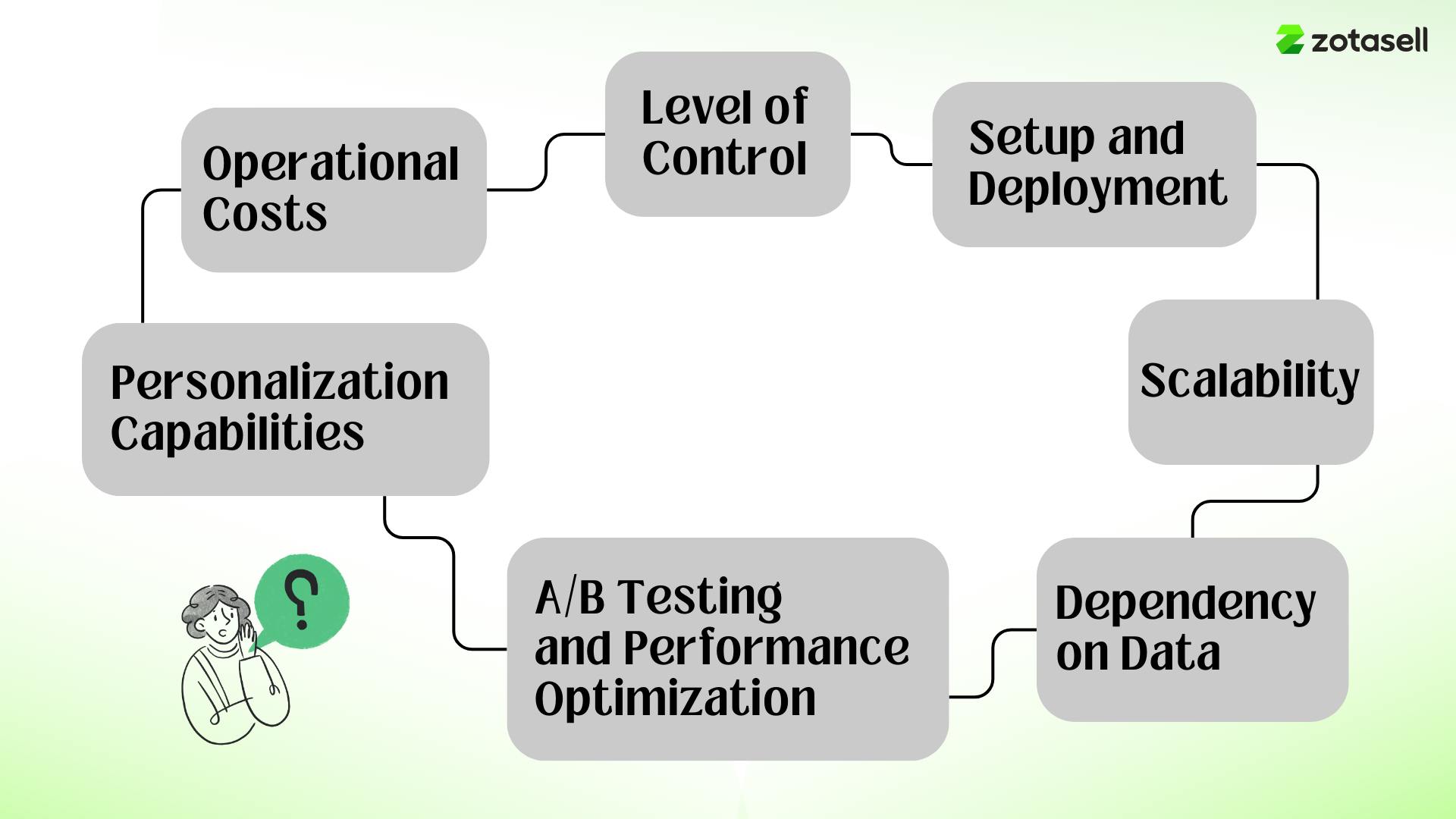
The comparison below is based not only on feature lists, but on real implementation patterns observed across small, mid-sized, and high-traffic Shopify stores.
1. Operational Costs
- Manual upsell: Initially appears cost-effective since it doesn’t require AI software. But hidden costs pile up as your store grows. For stores with over 50 products, manually setting and updating campaigns can take 10–15 working hours weekly. If you hire staff for this, labor and training costs rise. Poorly optimized campaigns can waste traffic, introduce inconsistent offers, and ultimately cap AOV growth as traffic scales.
- AI upsell: Usually involves a monthly fee ranging from $29 to $299+, depending on the platform. However, it automates the entire process, saving 60–80% of the time spent on setup and maintenance. According to Omnisend (2024), 76% of retailers using AI upsell save at least 5 hours per week compared to manual methods.
2. Level of Control
- Manual upsell: Gives full control over each campaign component-images, copy, timing, logic. Ideal for brands focused on custom messaging, voice, or brand experimentation. But with multiple campaigns running, maintaining consistency becomes challenging.
- AI upsell: Reduces management workload but limits granular control. You can define general rules (e.g., promote high-margin or overstocked items), but not dictate exact product suggestions. This suits brands that prioritize performance over manual personalization.
3. Setup and Deployment
- Manual upsell: Requires significant time to plan and set up. Creating 100 campaigns at 10–15 minutes each translates to 16–25 hours upfront-not including ongoing updates. Also, syncing with your theme may cause display conflicts if not tested carefully.
- AI upsell: Can be deployed in under an hour. Most AI tools only require enabling the widget, choosing placement, and letting the system learn user behavior. Once active, all you need is performance monitoring via dashboard-no ongoing intervention required.
4. Scalability
- Manual upsell: Becomes unmanageable once SKU count exceeds 100. As you expand to more markets or languages, the workload grows exponentially.
- AI upsell: Operates seamlessly regardless of product volume. It can process thousands of SKUs and adapt suggestions in real time-especially valuable during sales seasons or inventory rotations.
5. Personalization Capabilities
- Manual upsell: Personalization relies on fixed logic (e.g., if A, then B), usually based on collections, tags, or cart value. You can tailor messages for customer groups, but not at an individual behavioral level.
- AI upsell: Delivers near-instant personalization. For example, if a shopper views three moisturizing products, the system may recommend a whitening combo. According to McKinsey, 71% of consumers expect personalized experiences-AI is the bridge to meet that expectation.
6. A/B Testing and Performance Optimization
- Manual upsell: Lacks built-in A/B testing. To test variations, you must manually clone campaigns and analyze data via Google Analytics or other tools, slowing optimization and risking data inconsistency.
- AI upsell: Comes with built-in A/B testing and machine learning. The system tests variations automatically and deactivates low performers. Salesforce reports AI-powered testing can increase AOV by 17% within the first 30 days.
7. Dependency on Data
- Manual upsell: Doesn’t require user behavior data. Even new stores can implement manual upsell from day one-provided you have product logic in mind.
- AI upsell: The more data, the better the results. However, some platforms include progressive learning mechanisms designed to help newer stores accumulate data and improve recommendations gradually. For stores with 1,000+ sessions/month, AI typically yields visible results within 2–3 weeks.
IV. When to Choose Each Method
Based on repeated implementation and performance reviews across Shopify stores, the choice between manual and AI upsell consistently depends on store scale, operational capacity, and growth objectives.
Manual upsell is ideal when:
- You run a small store: With fewer than 30–50 SKUs, it’s easy to manage and doesn’t require new tools.
- You need full creative control: Customize your content, visuals, and timing in line with brand identity-perfect for unique or seasonal experiences.
- You’re running short-term campaigns: For example, holiday bundles, flash sales, or clearance items that need quick deployment.
- You’re not ready to invest in paid tools: Manual methods are free of software costs and good for testing early-stage ideas.
AI upsell works best when:
- You have a medium to large store (50+ SKUs): Manually managing everything becomes impractical. AI automates the process, saving dozens of hours monthly.
- You aim to personalize shopping experiences: AI tailors recommendations to individual behavior, history, and preferences.
- You want to continuously optimize with data: AI doesn’t just suggest-it learns and improves performance in real time.
- You run ads or have high traffic: With thousands of sessions per month, missing upsell moments can cost you. AI helps monetize every visit more effectively.
V. Real-World Performance and Industry Trends
Alongside industry research, many of these trends are reflected in day-to-day upsell performance data from live stores, particularly as traffic volume and SKU count increase.
1. AI adoption is accelerating
Over the past three to five years, multiple industry reports from firms such as McKinsey, Salesforce, and Omnisend have highlighted a clear shift from manual upsell strategies toward AI-powered recommendation systems. Leading global brands like ASOS, Sephora, and Walmart have adopted AI recommendation engines to suggest products based on real-time customer behavior automatically.
AI doesn’t just improve conversion – it enhances the entire shopping experience by personalizing what customers see and when they see it, across every touchpoint.
2. Manual still works – in niche cases
Despite the rise of AI, manual upselling still plays an important role in specific situations:
- For small stores with limited product catalogs
- When full creative control over messaging and design is required
- During short-term or seasonal campaigns, where the upsell strategy needs to be tailored
However, as your catalog grows or if you want to run multiple campaigns at once, manual upselling quickly becomes harder to scale, harder to maintain, and more prone to errors.
3. AI delivers stronger results
Industry research from McKinsey, Salesforce, and Omnisend confirms the performance advantage of AI-driven upselling:
- Conversion rates increase from 5–10% to as high as 22% when using AI-generated personalized recommendations
- Average Order Value (AOV) grows by 17–30% thanks to smarter, more relevant product suggestions
- Customer Lifetime Value (CLV) improves due to more engaging, tailored shopping experiences that drive repeat purchases
These aren’t isolated case studies – they reflect widespread gains across industries and store sizes.
4. AI transforms upselling
The real power of AI lies not just in automation, but in real-time optimization. AI tools constantly learn from customer behavior, adjust recommendations on the fly, and automatically run A/B tests to improve results.
Instead of relying on static rules and manual updates, AI turns upselling into a self-improving engine – one that works quietly in the background to grow your revenue, session by session.
VI. After Thought
These findings align closely with broader eCommerce benchmarks published by leading consulting and technology firms. While implementation details vary by store size and vertical, the performance gap between manual and AI-driven upsell systems has become increasingly consistent across the industry. There’s no single upsell strategy that works for every business. Your ideal approach depends on store size, team capacity, customer expectations, and growth stage.
Manual upsell gives you full control – perfect for smaller stores, branded campaigns, or situations where creative storytelling matters most. It’s flexible, easy to launch, and ideal when you want to customize every detail.
AI upsell, on the other hand, shines when scale and efficiency are priorities. It analyzes behavior in real time, personalizes recommendations automatically, and continuously optimizes performance without extra manual work.
For many merchants, the best strategy isn’t choosing one over the other – but combining both. Use AI to power daily operations and scalable personalization, while applying manual upsell at key brand moments where precision and creativity are essential. At its core, successful upselling is about relevance. When your strategy aligns with what customers actually want, every upsell becomes a value-added experience – not just a tactic to increase order value, but a reason for them to come back.

Join in our newsletter
Need more detail?
Access our Help Center & Resources to learn how Zotasell works, explore use cases, and share with your team.